
Observing Biblical Issues is a Party Trick?
If you dare to read the Bible carefully and critically, and then point out the observed issues, you too may be accused of undermining faith.

PSA: Pointing out a biblical story doublet, contradiction, error, or anachronism is not inherently an attack on faith.
*This is a response article to a few cranky voices I’ve heard lately.*
Bringing up and discussing biblical observations like contradictions, doublets, inaccuracies, anachronisms, and the like, is not merely some clever party trick used to destroy people’s faith.
It’s not like one can use the same trick to reveal how the Declaration of Independence contains an anachronism where it talks about a Windows 95 computer.
It’s not like the same trick can be used to tease out how Antigone (Sophocles) contains two completely separate stories by different authors that have been conflated and massaged into one, albeit with visible seams.
The reason scholars can so easily point out these biblical issues is 1.) Due to carefully and critically paying attention to what the text actually says, and more importantly 2.) Because these things actually exist in the text!
They are not conjured up out of thin air. This isn’t simply some Bible hating trick learned in the school of Satanic thought or taught in heretical liberal universities.
Getting upset at someone pointing out these issues makes about as much sense as getting upset at your doctor for finding a concerning spot on your skin. It’s simply there. You can either stick your head in the sand and scream “lalala” or you can actually do something about understanding it.
You’ve probably read right over these issues simply because you’ve never looked for them. You’ve probably missed them because they were intentionally bypassed by your teachers.
It’s not anyone’s “fault” for finding it. That’s as nonsensical as saying someone is at fault for “finding” the moon.
Those chastised for bringing up these issues could rightly turn this back around and say “Why haven’t you bothered to carefully read the text you so boldly declare is of the upmost importance? Why are you ignorant of that which you claim is foundational to your life?”
Pretending the issues aren’t really issues because our finite brains are incapable of understanding “God's word” is idolatry. It’s blind worship to your new idol, the Bible itself. It has been made into something the authors never intended, nor had anyone believed until relatively recently in history.
Let’s see some of these issues.
Two different creation stories
The Genesis 2 account is older and written with a different theology in mind. God in this account is more anthropomorphized. It walks and talks face-to-face with its creation. This creation account has God looking slightly less competent.
The Genesis 1 account is written by a later source that is attempting to blend two histories together. It fixes the issues with God’s actions from the first account. It retrojects the Sabbath into creation. God is more heavenly in this one.
These two accounts are not able or meant to be rationally harmonized. They simply disagree in a few places. It just means there were different traditions and needs of the biblical authors.
An offended nation that didn’t exist yet
This is a good example of an anachronism. In Genesis 34:7, Shechem defiles Jacob’s daughter. This causes outrage in Israel, but Israel doesn’t exist yet.
This is later editorial gloss, but it does reveal the mind of the author at the time of composition.
Two different flood stories
Here we have another doublet. The two creation stories are clearly separate, but here, in the flood itself, they have smashed two stories together.
It’s hard to say why they did this here and not with creation, but that’s part of the fun mystery! You can tease apart these stories to some degree, as you find contradicting numbers and strange sentence arrangement that give this away.
Nephilim surviving the flood
The Bible says that everything that had breath was killed in the flood. Every living thing died. People, animals, creatures, etc. Yet these Nephilim somehow, according to Gen 6:4, were around after the flood too. For those wondering, that does in fact make them alive. 🤣
There are a few theories here, but the one that makes the most sense to me is that of merging people groups. They needed a way to explain why these other (older) tales of the Nephilim around after the flood could be plausible if everything died in the flood. They weren’t on the ark of course. A later author likely went back and shoved this verse into Gen 6. Boom. Problem fixed. They were around afterwards too. Does it make total sense? No, but it doesn’t matter. There’s a license for those later stories now.
Joseph being sold into slavery
Here we have another doublet. We have a case where there are two different stories being merged of how Joseph wound up being sold and eventually landed in Egypt.
Like the creation stories, these two are also contradictory. Scholars have even been able to tease these apart and display the standalone side-by-side stories.
Moses being given the divine name
I appeared to Abraham, Isaac, and Jacob as God Almighty, but by my name ‘The Lord’, I did not make myself known to them.- Exodus 6:3 NRSVUE
God tells Moses His name, yᵊhōvâ, and that by this name He did not make Himself known to Moses’ ancestors. However God is regularly referred to as yᵊhōvâ by those people.
Keep in mind we are seeing the merging of several sources of material in the Pentateuch. Each source has its own traditional stories and ways it likes to refer to God. Here we see an incongruity that the scribes apparently weren’t too bothered by, but it does reveal a small interesting piece of how each group had developed.
David killing Goliath?
1st Samuel says David did it. 2nd Samuel say Elhanan did it.
Text criticism would favor of Elhanan doing the deed, as it wouldn’t make sense for a much lesser figure (hardly even mentioned) to be reattributed this killing. It would make a lot of sense for a well known figure to plagiarize that conquest for themselves.
The later redactor in 1st Chronicles (a very pro-Davidic-legacy author) tries to smooth this over by saying Elhanan killed the brother of Goliath.
David taking the census
See my article on saying no to the Bible for a more in depth examination of this.
Essentially a later author didn’t like the way the original story depicted God as the deceiving agent for David. This was a later post-exilic author that had exposure to Zoroastrianism. As such, they had a change in theology to believe a specific evil being was responsible for all the bad things. Here they reattribute that temptation to Satan.
John’s disagreements with the synoptics
John and the synoptics often have disagreements.
This is just the author of John doing his own thing, arranging things for his narrative purposes.
Matthew and Luke: Jesus’ birth story
Luke plausibly did not originally contain a birth narrative. Neither Mark or John record the birth of Jesus.
The birth narrative may have been the result of later theological needs of the communities in which the gospels were being written. Perhaps the story evolved or Luke just felt like Matthew was in error. In any case, there are contradictions here.
The disagreeing resurrection accounts
There are many differences among the gospels with this story. Some are understandable from a “we saw the same thing but from a different angle” way. Some differences are considerably more significant and it deserves sitting with what that means.
These differences make sense if you consider the authors are basing their writing on 2nd & 3rd-hand accounts, many decades afterward.
Mark probably never had one, which along with some other curious textual details, raises a much bigger question on how that account came to be in the first place. (that's too heavy to unpack here)
When you add up all the contradictions, historical inaccuracies, errors, anachronisms, editorial gloss/redactions, doublets, etc, you wind up with a number of observations that stretches into triple digit territory.
This is only as big of a deal as your view of the Bible causes it to be.
You can be mad that someone talks about them, but let’s be clear at what you’re really upset at. You’re upset that your particular view of what scripture must be is undermined by these things. The root of your anger is not that you have no reasonable argument to the issues themselves (which you probably don’t). The root of the matter is this; to acknowledge these things means you might have believed a wrong idea for years. The sunk-cost fallacy grass is greener for you than the unfenced new idea pasture you could have had, and that stings.
Don’t get mad at someone who exposes a problem. They didn’t create the problem.
This phenomenon gives off very shoot the messenger or persecute the whistleblower vibes. In hindsight, that’s never historically been a good look for anyone.
Examining these textual issues can reveal things like:
Authorial disagreement
Fraudulent insertions
Later redaction
Non-historical nature of the story itself
Translation problems
Scribal mistakes
An intentional cover-up
Merging stories
Author’s ignorance
Unsurprisingly, the Bible plainly contains all of the above. Depending on which version you’re reading, you can open your own Bible and witness it tell you exactly that on occasion in the footnotes/commentary.
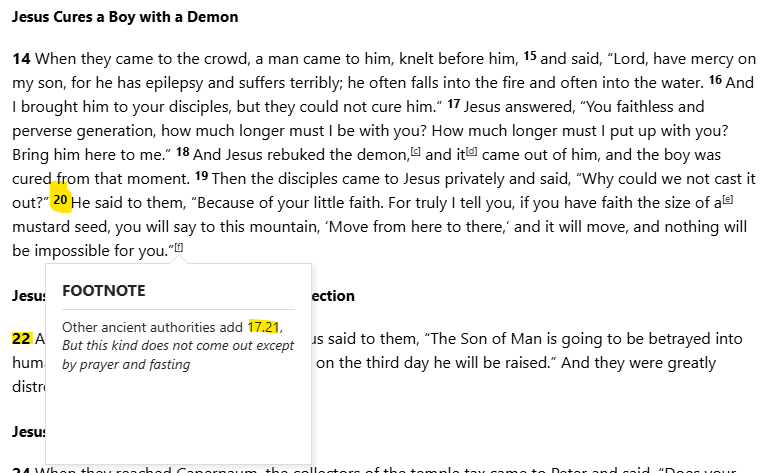
Do you hate your own Bible? How dare it say such a thing right? Or do you skip right past those footnotes and commentary too?
It is telling that you have mistaken critical intellectual observation for a cheap trick.
It’s plainly obvious that your idea of what the Bible must be was created without any knowledge of what the Bible actually is.
A person will miss out on a wealth of information if they cannot accept that these issues even exist in the first place.
You can’t appreciate the stark differences in opinion that biblical authors have, because you can’t acknowledge the contradictions that reveal those opinions exist. Everything must be harmonized.
You can’t appreciate the historical context of a book if you won’t acknowledge it as written centuries after tradition holds.
You can’t appreciate the biblical authors pulling their mythology from their surrounding mythology if you have to believe this was was the direct inspired word of God as factual history.
You can’t appreciate the in-Bible Christological development driving differences in tone/style/language, if you start from a framework of perfect harmonizing inerrancy from the first letter stroke.
You can’t appreciate the depth of sorrow and anxiety experienced by the exiles crafting the exodus narrative if you are forced to believe the that the exodus was literal history as written by Moses.
You can’t appreciate the devotion to David that the authors of chronicles had if you can’t acknowledge that this was redacted, revised, and revisionist history.
You can’t appreciate the rampant fear within John the Revelator’s community if you have to understand Revelation as speaking about a day in the future.
You can’t appreciate the letdown Ezekiel felt when his prophecy failed, if you have to reinterpret history to somehow make this not a failure.
You can’t appreciate Deutero-Isaiah’s excitement about what was happening in his day if you to assume the whole book was written pre-exile.
In short, you’ll never get to experience the Bible for what it is.
That’s a shame. You’re missing out on some truly interesting history.
If you want to call that a party trick....please don’t ever invite me to any of these parties you’ve been going to.
Peace
Understanding these issues make me appreciate the human element, the power of myth and legend, the importance of Midrash to have discernment and choosing wisely against competing Bible stories. This isn’t just getting back to the Jewish roots of the Scriptures, it’s reading the Scriptures like ancient Jews who would understand these biblical stories better than our modern Enlightenment systematic readings of these biblical stories.
Very good 😎
Oh, and.... I hope I'm not cluttering up the comments too much, but thanks also for the discussion of how this is just textual criticism--the same kind we do for Antigone or whatever. In my case, the same things I do with 7th-12th-century Byzantine texts. People are so sure that we "pick on the Bible".... It's just textual criticism, darn it.